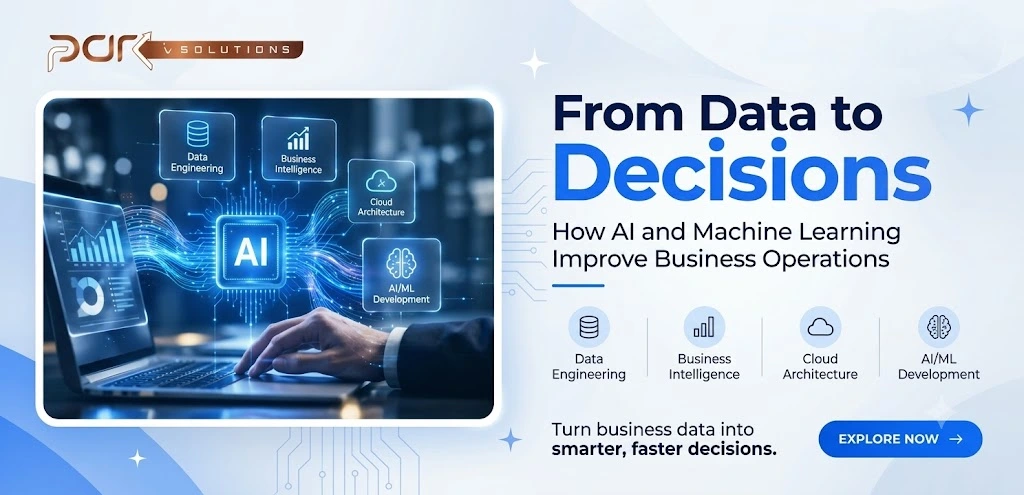
From Data to Decisions: How AI and Machine Learning Improve Business Operations
Every business we work with has more data than it knows what to do with.
Spreadsheets nobody opens twice; dashboards built with good intentions and then quietly ignored, monthly reports that get skimmed once and filed away. The problem was never a shortage of data. It’s the gap between having numbers and acting on them.
That gap is exactly where artificial intelligence and machine learning earn their keep – not as buzzwords bolted onto a slide, but as the actual machinery that turns raw numbers into a decision someone can make the same day.
We’ve watched this play out across finance teams, supply chains, and IT departments in the US, the Gulf, and everywhere in between, and the pattern is always the same: the businesses that treat AI as infrastructure, not a side project, are the ones who actually see results.
Data Engineering Services: The Unglamorous Backbone Behind Every AI Win
“Why does an AI project succeed at one company and quietly die at another?”
Nine times out of ten, it has nothing to do with the algorithm. It comes down to what’s feeding it. Data engineering is the unglamorous work of collecting, cleaning, and structuring information from every system a company runs – CRM, ERP, spreadsheets someone built in 2019 – before any model gets near it. Think of it as plumbing. Nobody notices it when it works, but everything backs up the moment it doesn’t.
This is why serious data engineering services quietly decide whether an AI model performs like magic or collapses the first time it meets messy, real-world numbers. Good pipelines mean fresh, accurate data flows in automatically. Bad ones mean someone’s manually patching spreadsheets at 11pm before a board meeting. We’ve seen both, and the difference shows up in every single number the business trusts afterward.
What solid data engineering actually covers:
- Cleaning and standardizing data pulled from multiple, often disconnected systems
- Automating pipelines so information updates without manual intervention
- Structuring data warehouses that models and analysts can actually query
- Catching errors and inconsistencies before they reach a dashboard
Business Intelligence Outsourcing and the Rise of Predictive Analytics
“The data’s clean now – so what actually turns it into a decision?”
This is where classic reporting stops and predictive analytics starts. Traditional business intelligence looks backward: what sold last quarter, where costs rose. Traditional business intelligence looks backward: what sold last quarter, where costs rose. Predictive analytics use those same historical patterns to project forward, spotting trends before they show up in a quarterly review instead of after.
Building this in-house is expensive and slow, which is exactly why Business Intelligence Outsourcing has become the practical route for mid-sized and growing companies. Rather than hiring a full analytics team from scratch, businesses bring in a partner who already has the models, the tooling, and the experience – and gets forecasts running in weeks, not a year of trial and error.
Where this shows up in daily operations:
- Demand forecasting that keeps inventory levels realistic
- Customer churn prediction before a client actually leaves
- Cash flow projection for tighter financial planning
- Risk scoring used in lending, insurance, and credit decisions
Cloud Architecture Services: Where These Models Actually Live
“Where do all these models run once, they leave the whiteboard?”
On servers a company owns outright; most models age badly – too rigid, too expensive to scale, too slow to update. Cloud computing solved this by making compute and storage elastic: pay for what’s used, scale up during peak demand, scale back down after.
For companies operating across regions, this matters even more. Thoughtful cloud architecture services account for where data physically sits, which is a real compliance question for regulated industries and for clients working across US and Gulf jurisdictions with different data residency rules. Getting this architecture right the first time saves months of rework later.
What good cloud architecture delivers:
- Scaling compute resources up during busy periods and down afterward
- Hosting models closer to users for lower latency
- Meeting data residency and compliance requirements by region
- Cutting the cost of maintaining physical, on-premise servers
AI ML Development Services: Teaching Machines to Recognize What Matters
“What’s actually the difference between ordinary software and an AI model?”
Ordinary software follows rules someone wrote. An AI model learns patterns from examples. In supervised learning, it’s trained on labeled data – thousands of past transactions marked fraud or not fraud – until it can flag new ones on its own. Unsupervised learning skips the labels entirely and hunts for patterns nobody explicitly pointed out, which is how many anomaly detection catches problems humans didn’t think to look for.
Putting this to work is what AI ML development services are really about – not research for its own sake, but models built around a specific operational problem. Natural language processing reads and sorts contracts, emails, and supports tickets. Computer vision checks a production line for detecting faster than a human ever could and doesn’t get tired of doing it.
Common ways this gets implemented:
- Supervised learning for fraud detection or defect identification
- Unsupervised learning for spotting unusual, unlabeled patterns
- NLP for processing contracts, emails, and customer queries
- Computer vision for automated quality inspection
24/7 IT Support Outsourcing: Who’s Watching the Model After Launch?
“AI systems don’t stay accurate forever on their own – so who’s actually checking?”
Models drift. Customer behavior shifts, markets move, and a model trained on last year’s patterns slowly gets things wrong in ways that aren’t obvious until the numbers are already off. Nobody notices until a forecast misses badly enough to hurt.
This is precisely why 24/7 support outsourcing matters as much as the model itself, especially for companies running operations across US and Middle East time zones where “business hours” barely exist. It’s one piece of the broader specialized business services a mature AI setup need – the ongoing monitoring, retraining, and quiet fixing that keeps a system trustworthy months after launch, not just on day one.
What ongoing support actually involves:
- Monitoring model accuracy on a regular schedule
- Retraining models as new data changes the patterns
- Fixing pipeline breaks before they distort a report
- Providing round-the-clock coverage across time zones
Where Park Intelli Solutions Fits into All of This
Park Intelli Solutions was built around running data engineering, business intelligence, cloud architecture, and AI/ML development as one connected practice, rather than services bolted on from different providers. It’s the difference between a team that understands the whole pipeline and one that only understands its own slice of it – and it’s why the process always starts with an honest look at what a business already has, before a single model gets built.
Data was never the hard part. Turning it into a decision someone’s willing to act on is the real work, and that’s the exact space Park Intelli Solutions operates in every day — building the data pipelines, cloud architecture, and AI models that let businesses across the US and Middle East make faster, more confident calls.
If any of this sounds like a gap your own operations team has been quietly working around, that’s usually the sign it’s worth a real conversation with us.
Contact Us:
Email: info@parkisolutions.com
Phone: +91 422 312 0000 , +1 281 220 6808
Share Social Media
Category
Recent Posts
- From Data to Decisions: How AI and Machine Learning Improve Business Operations
- Preparing Your Tech Stack for AI: A Comprehensive Guide to Future-Proofing
- Effortless Bookkeeping, No Commitments: Park Intelli Solutions’ Seamless Strategy
- Boosting Business Performance: Why Sales-as-a-Service is Key for Modern Enterprises
- Timing is Key: Determining the Right Moment for Your Business to Integrate AI
