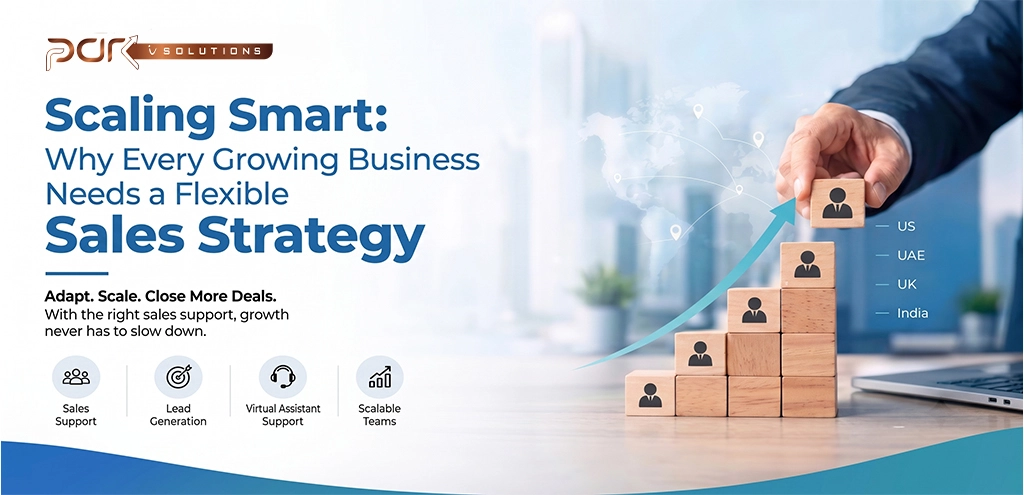
Scaling Smart: Why Every Growing Business Needs a Flexible Sales Strategy
Every growing company reaches the same point eventually: the leads start coming in faster than the sales team can work them. A two-person team that handled inbound comfortably six months ago is now stretched across follow-ups, proposals, and closing calls at the same time. That gap between demand and capacity is exactly where sales as a service outsourcing becomes relevant – not a stopgap, but as a structural fix for how sales teams are built in the first place.
Growth Rarely Waits for Hiring to Catch Up
Business growth is rarely linear, and sales capacity almost never keeps pace with it. One month it’s a trickle of inbound interest from a campaign in London’s Canary Wharf, the next month it’s a surge of inquiries following a trade event in Dubai’s DIFC district. Traditional hiring can’t move that fast. Recruiting, onboarding, and training a new sales hire takes months – industry benchmarking from The Bridge Group’s SaaS sales research puts average ramp time for a new B2B sales hire at over five months before they are fully productive. Companies across the US, UAE, UK, and India keep running into the same wall: by the time a new hire is ramped, the market has usually already moved.
Size was never really the goal, responsiveness was. A smaller team that flexes with demand tends to outperform a larger one locked into a hiring plan drafted a year earlier, mostly because it can actually respond when the numbers shift.
The Real Cost of an Inflexible Sales Structure
The cost of a rigid sales team rarely shows up where you’d expect. When a business hires permanent staff to cover seasonal spikes, it often ends up paying full salaries through the slow months just to have coverage ready for the busy ones. Flip that around and the problem reverses: demand surges, the team is too small, deals sit untouched until they go cold, and cold leads rarely come back around. It’s a pattern that turns up across industries – real estate firms managing valuation inquiries in Mumbai, financial outsourcing clients handling seasonal accounts receivable calls out of New York, the specifics change but the math doesn’t.
Then there’s the cost that never makes it onto a spreadsheet. A sales team stretched too thin starts cutting corners on follow-ups and losing the consistency that actually closes deals, and turnover tends to follow not long after. This is exactly the gap specialized business services are built to close, filling in the operational strain before it turns into lost revenue.
Flexibility Is a Structural Advantage, Not a Trend
What separates businesses that scale well from ones that stall usually comes down to how fast they can adjust sales capacity without a lengthy hiring or restructuring cycle. A flexible model lets a team scale up for a product launch and scale back once that initial demand settles, no severance conversations, no long notice periods, no awkward in-between. Sales capacity should match demand, not work against it, and that’s really the whole case for treating Sales-as-a-Service outsourcing as an operating model rather than a stopgap.
What a Flexible Sales-as-a-Service (Saas) Model Looks Like in Practice
A properly structured outsourced sales function works alongside internal leadership, following the company’s process, tone, and targets, while adding the elasticity to expand during peak periods and pull back when things quiet down. It often pairs with a lead generation agency function too, so the same partner filling the pipeline is also equipped to help convert it, which closes a gap that tends to open up between marketing and sales. Add in support like virtual assistant services for business, and the administrative load – scheduling, CRM updates, quote follow-ups – stops falling on the people who should be closing deals instead.
Some months that resource stays lean, focused on nurturing leads that are already warm. Other months, when a campaign lands or seasonal demand rises, it scales up without waiting on a hiring cycle to catch up.
The obvious question at this point is why not just hire more staff instead. Hiring adds headcount but locks a business into that headcount whether demand holds or not, and a new hire still needs months to reach full productivity regardless. A flexible SaaS model deploys faster, moves in both directions as demand shifts, and shows up with training and process already built. That gap in speed and adaptability is usually what tips the decision.
What a Sales-as-a-Service Partner Actually Takes On
Outsourced sales support covers more ground than most people expect the first time they look into it. Lead qualification and prospect outreach are the obvious pieces, and appointment setting keeps the pipeline moving even on weeks when the internal team is buried in something else. But the part that tends to matter more day to day is the follow-through: quotes that would otherwise sit unanswered for a week, CRM entries that never get updated because everyone’s on calls, deals that need one more nudge to close, reporting that leadership actually has time to read.
None of this touches the relationships or product knowledge your own team has built, and it isn’t meant to. It just takes the repetitive, time-sensitive work off their desks so they can spend their hours on the parts of a deal that actually need a person who knows the business. For companies also handling high call volumes, this kind of setup often overlaps with broader knowledge process outsourcing, where the same operational discipline applies to support and back-office work, not just sales.
Regional Differences Worth Noting
The need for flexibility shows up everywhere, but it doesn’t look identical in every market. US companies tend to lean on this kind of support around quarter-end, when a campaign tied to a market like New York or Chicago can double inbound volume overnight. In the UAE, cross-border deals move fast, and businesses working through Dubai’s commercial district often need specialists already familiar with regional buying habits rather than someone learning on the job. UK firms have used the model more for testing, trying a new vertical without committing to headcount before they know it will work. India’s pattern looks different again, since demand in tech hubs like Bengaluru can shift within a couple of weeks, not a couple of quarters, and hiring simply can’t keep pace with that.
Different reasons, same root problem: sales capacity that doesn’t move as fast as the business does.
Bringing This In Without Overhauling What Already Works
Adopting this model doesn’t mean replacing your existing sales team, and most companies that go this route don’t start there anyway. It usually begins narrower than that. Someone on leadership notices the team is stretched during a specific stretch of the year, or a new market opens up faster than hiring can support or inbound simply outpaces what the current headcount can handle, from there, a flexible sales partner can be introduced around the existing structure, managing lead qualification through closing support while the internal team focuses on strategy and client relationships. Many businesses find that this hybrid approach becomes a permanent part of how they operate, not because it is temporary, but because it performs more reliably than forecasting headcount a year in advance.
This also changes how leadership approaches planning. Rather than building annual hiring forecasts around estimates, teams start planning around actual demand signals, adjusting sales capacity the way they’d adjust inventory or marketing spend. And working with an external sales partner doesn’t mean losing visibility – a capable one reports on activity, pipeline movement, and conversion trends the same way an internal team would, so accountability stays intact even as the burden of staffing every fluctuation internally disappears. Many businesses pair this with a broader digital marketing agency partnership too, so the same flexible thinking that fills the sales pipeline also drives the demand feeding into it.
At Park Intelli Solutions, part of Park Corporates, this is the model we build for clients across the US, UAE, UK, and India, combining sales as a service outsourcing with the lead generation and virtual assistant support needed to keep a pipeline moving consistently. The goal is not to replace a sales team. It is to give that team room to grow. If your sales capacity needs to move at the same pace as your pipeline, Park Intelli Solutions can help build a flexible sales support model suited to your business – because a pipeline that outgrows its own team isn’t a success story yet, it’s just a warning sign with better numbers attached.
Contact Us:
Email: info@parkisolutions.com
Phone: +91 422 312 0000 , +1 281 220 6808
Share Social Media
Category
Recent Posts
- Scaling Smart: Why Every Growing Business Needs a Flexible Sales Strategy
- From Data to Decisions: How AI and Machine Learning Improve Business Operations
- Preparing Your Tech Stack for AI: A Comprehensive Guide to Future-Proofing
- Effortless Bookkeeping, No Commitments: Park Intelli Solutions’ Seamless Strategy
- Boosting Business Performance: Why Sales-as-a-Service is Key for Modern Enterprises
